Auto Rickshaw Branding: When Your Brand Becomes Part of Everyday Movement

Auto advertising by ACME Advertising

Every city moves with a rhythm. Morning commutes, delivery routes, school runs, and evening traffic create a continuous flow across roads and neighborhoods. Within this movement, certain visuals begin to repeat — a branded cab at a signal, an auto passing through a market, a vehicle seen again on another route.

Over time, these repeated sightings create familiarity. The brand is no longer new. It becomes part of what people see every day.

This is where auto rickshaw branding creates real value. It allows brands to travel through the same routes people use daily, building recognition through presence rather than interruption. For businesses looking to expand visibility across multiple locations at once, auto rickshaw branding offers a practical and scalable solution.
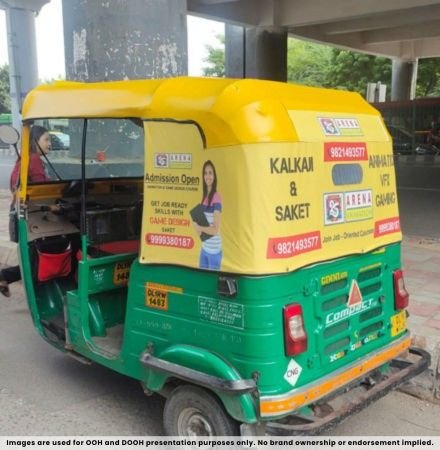
Auto rickshaw hood branding advertising campaign on road – transit advertising

Table of Contents

Understanding Auto Rickshaw Branding

Auto rickshaw branding refers to placing brand visuals on moving vehicles such as cars, taxis, auto rickshaws, vans, and commercial fleets. These visuals are applied using high-quality vinyl wraps, decals, or panels designed to remain durable under daily usage.

Auto rickshaw branding is commonly used for:

  • Citywide brand awareness
  • Product and service promotions
  • App-based and digital-first businesses
  • Retail and local market visibility
  • Service-based business outreach

Because vehicles operate throughout the day, they carry brand messages across different areas, supporting repeated exposure across routes and commuter journeys.

How Auto Rickshaw Branding Works in Real Conditions

Auto rickshaw branding begins with planning — not just design, but movement. The goal is to ensure the vehicle travels through locations where visibility naturally occurs.

The process typically involves:

  • Selecting vehicle types based on campaign goals
  • Designing clear and readable creatives
  • Applying vinyl branding on key vehicle surfaces
  • Mapping routes across high-traffic areas
  • Deploying vehicles for consistent daily movement

Once active, the vehicle continues its regular operations while carrying the brand across multiple touchpoints throughout the city.
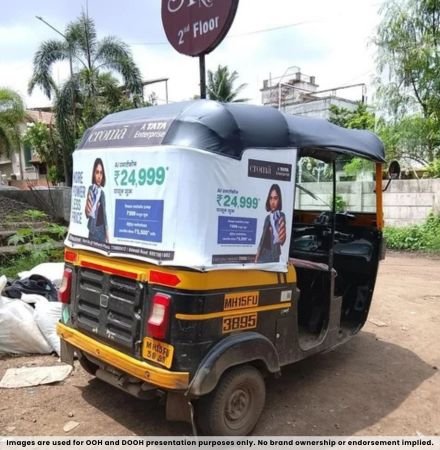
Auto branding campaign with rear hood advertisement display in urban area

Where Recognition Starts to Build

Imagine a commuter waiting at a signal. A branded auto stands nearby. Later in the day, a similarly branded cab passes through a market area. The next day, the same visual appears again near an office zone.

These repeated sightings build familiarity.

Auto rickshaw branding supports this by:

  • Appearing across different parts of the city
  • Reaching audiences during daily travel
  • Reinforcing recognition through consistency

With time, the brand becomes easier to recall because it is seen often, not just once.

Types of Auto Rickshaw Branding Formats

Auto rickshaw branding offers multiple format options depending on visibility goals, vehicle type, and campaign scale. Each format focuses on how the message is seen in motion.

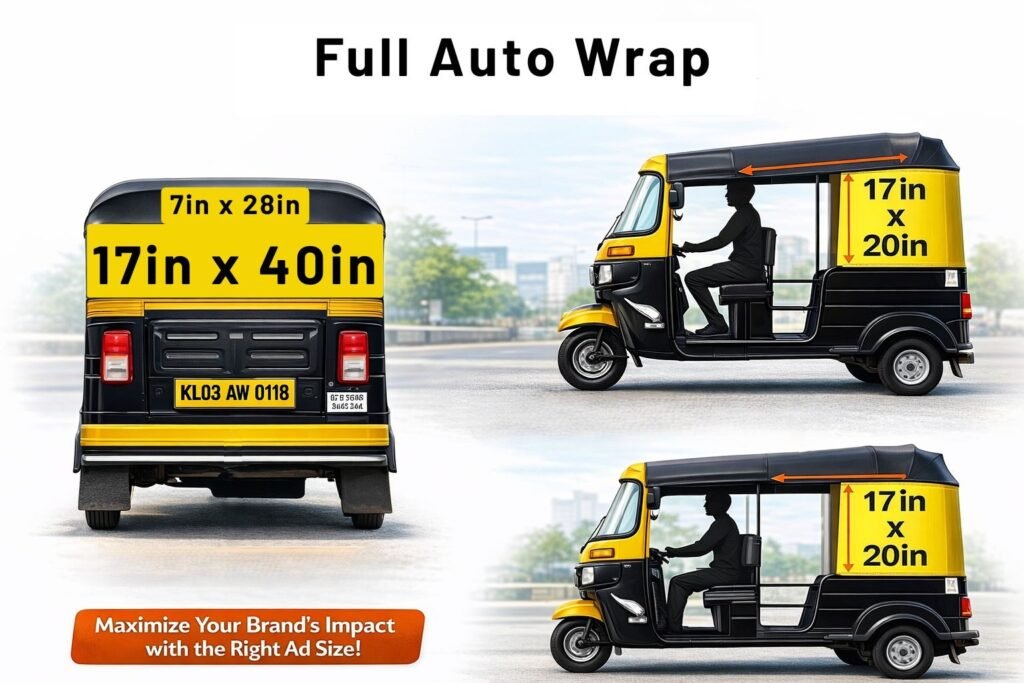
Full Auto Wrap

  • Covers the entire vehicle body
  • Creates strong road presence
  • Suitable for large campaigns
Auto branding campaign with rear hood advertisement display in urban area

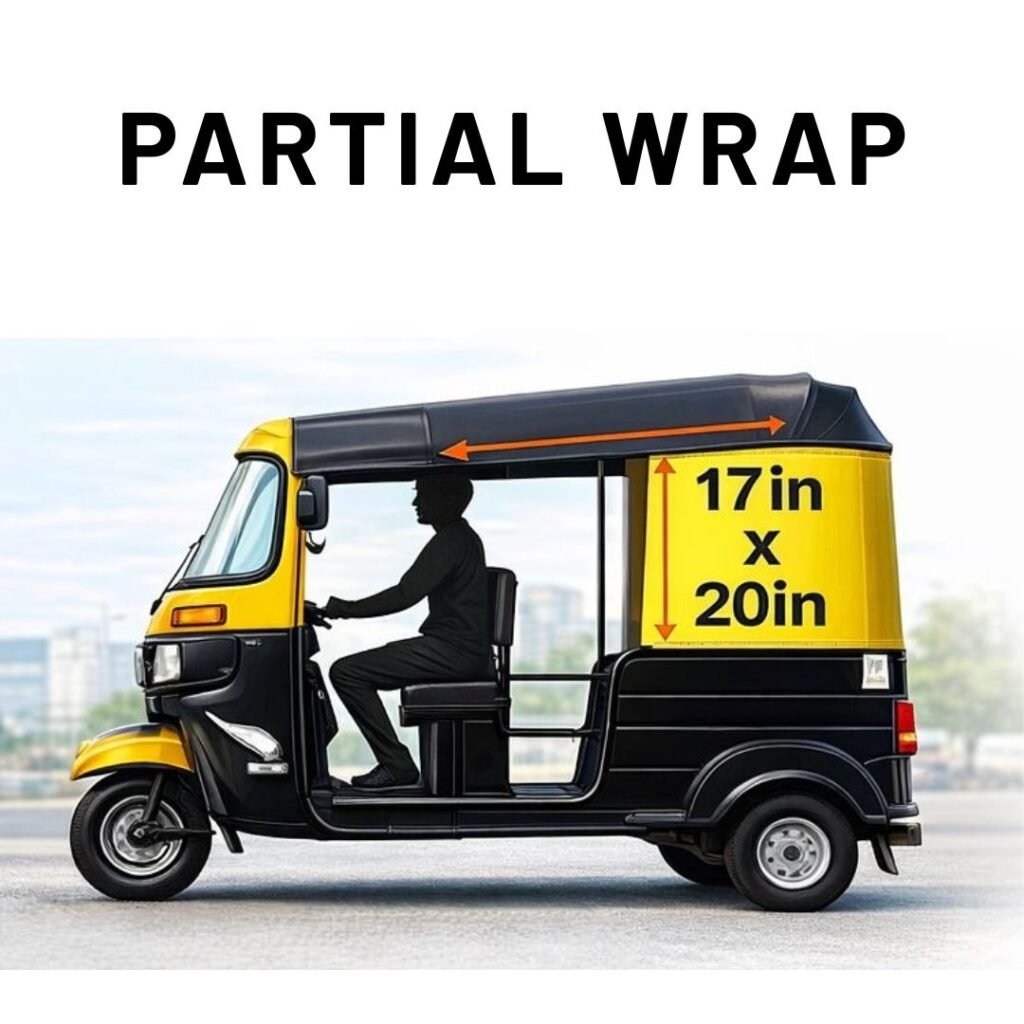
Partial Wrap

  • Covers selected sections like side panels or rear areas
  • Balances visibility and cost
Auto branding campaign with rear hood advertisement display in urban area

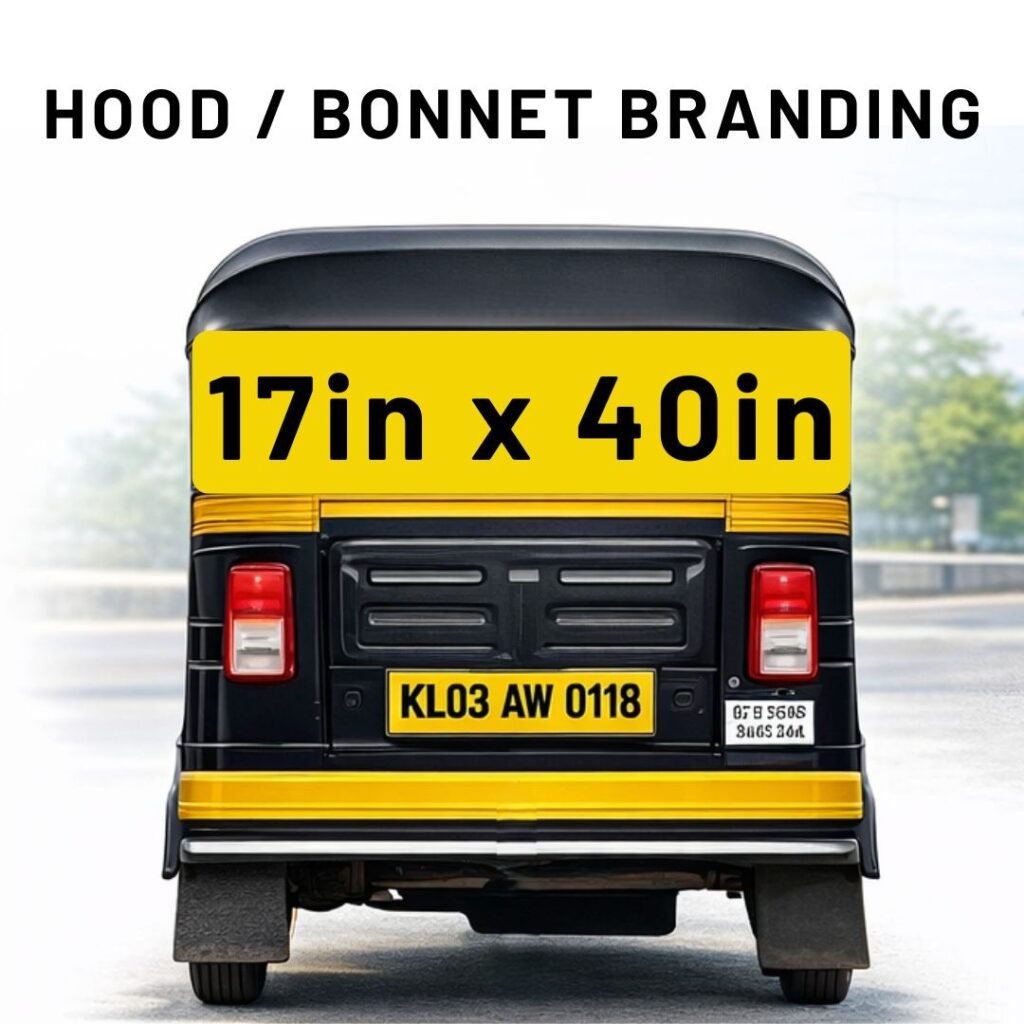
Hood / Bonnet Branding

  • Visible from front angles and intersections
  • Adds another layer of exposure
Auto branding campaign with rear hood advertisement display in urban area

Each format allows brands to build visibility across multiple viewing angles without overloading the message.
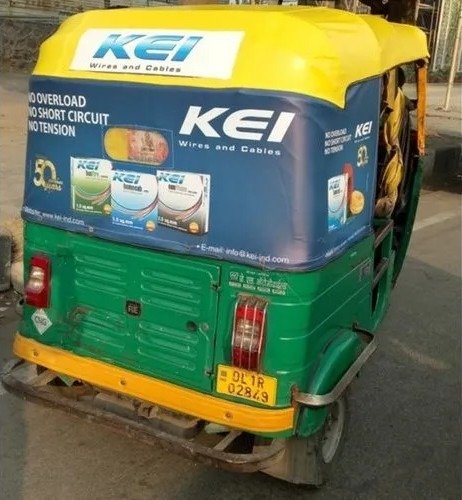
Auto rickshaw branding campaign with full rear vinyl advertisement wrap

Standard Sizes in Auto Branding

Auto branding sizes vary based on the type of vehicle and format used. The focus is always on readability while the vehicle is in motion.

Common size references include:

  • Car door panels: approx. 2.5–3.5 feet width
  • Auto rickshaw back panels: approx. 3 x 2 feet
  • Side panels: 4–6 feet length depending on vehicle
  • Hood branding: 2–4 feet area
  • Full wraps: complete vehicle coverage
  • Internal panels: customized based on vehicle interiors

Proper sizing ensures the message remains clear even when viewed briefly.

Why Businesses Invest in Auto Branding

Auto branding allows brands to remain visible across multiple locations without being restricted to a single placement. As vehicles move, the brand message travels with them.

This supports businesses by:

  • Expanding reach across city routes
  • Creating repeated exposure during daily movement
  • Maintaining visibility across different audience groups
  • Supporting presence in both residential and commercial areas

Instead of waiting for customers to come across a brand, the brand moves alongside them.
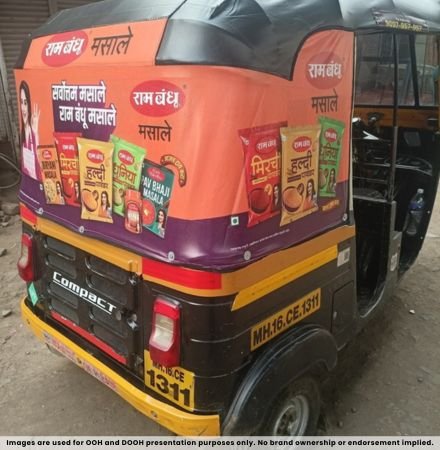
Auto hood branding advertisement for FMCG product on city roads

How Auto Branding Supports Business Growth

Visibility often leads to familiarity, and familiarity supports decision-making. Auto branding helps businesses build that familiarity across real-world environments.

It contributes to growth by:

  • Strengthening brand recognition
  • Supporting recall when customers need the service
  • Improving response to other marketing channels
  • Building consistent local presence

When people repeatedly see a brand during their daily travel, it becomes easier to remember when a requirement arises.

Strategic Route Planning Drives Results

The effectiveness of auto branding depends heavily on where the vehicles operate. Movement should align with audience activity.

Planning typically considers:

  • High-traffic corridors
  • Commercial and retail zones
  • Office districts
  • Residential catchment areas
  • Transit hubs and airport routes

When routes are selected carefully, the brand becomes part of everyday city movement.
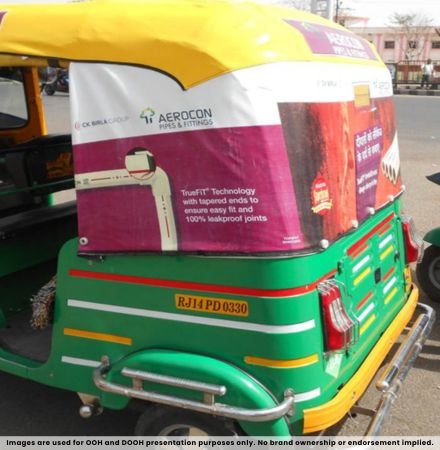
Auto rickshaw branding campaign with full rear vinyl advertisement wrap

Creative Simplicity Keeps the Message Clear

Vehicles are seen for a few seconds, so clarity is essential. A simple and bold design ensures quick understanding.

Effective auto branding focuses on:

  • One strong message
  • Bold, readable typography
  • Clear brand identity
  • High-contrast visuals

Simple creative ensures the message is understood instantly, even in motion.

Cost Stability and Campaign Flexibility

Auto branding provides structured visibility with predictable costs. Once deployed, vehicles continue to carry the message throughout their operation.

Key advantages include:

  • Stable campaign investment
  • Flexible duration
  • Scalable fleet size
  • Continuous exposure without repeated setup

This makes it suitable for both short-term promotions and long-term branding.
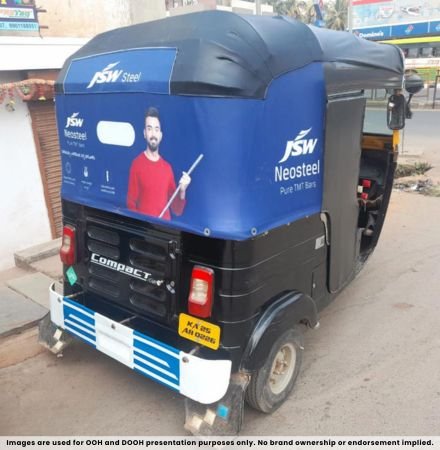
Transit advertising on auto rickshaw with rear hood branding display

Industries That Benefit From Auto Branding

Auto branding is widely used across industries that require strong local and citywide visibility.

Common sectors include:

  • E-commerce and delivery platforms
  • Food and beverage brands
  • Real estate companies
  • Healthcare services
  • Retail and local businesses

Any business that wants to reach people across daily routes can benefit from this format.

Measuring Impact Through Real-World Signals

Auto branding does not depend on immediate actions. Its value appears through recognition and familiarity.

Businesses often observe:

  • Increased brand recall
  • More inquiries from familiar audiences
  • Better response to integrated campaigns
  • Stronger local awareness

These results build gradually through consistent exposure.
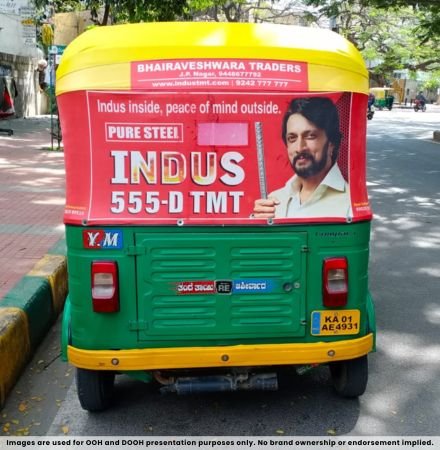
Auto rickshaw hood advertising with full back panel branding display

Long-Term Value of Moving Visibility

Each sighting may last only a few seconds, but repeated exposure across weeks builds strong memory. Auto branding turns daily movement into continuous brand presence.

Over time, this supports:

  • Stronger top-of-mind awareness
  • Consistent market visibility
  • Improved brand familiarity
  • Greater confidence during decisions

Visibility that moves often stays remembered.

Final Perspective on Auto Rickshaw Branding

Auto branding works because it aligns with how cities function. Vehicles travel through the same routes people use every day, allowing brands to stay present without disruption.

It is not about a single impression. It is about being seen again and again.
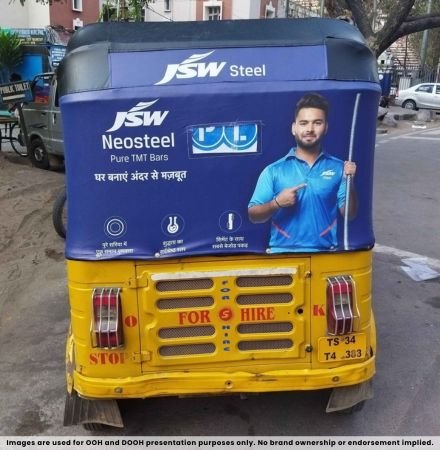
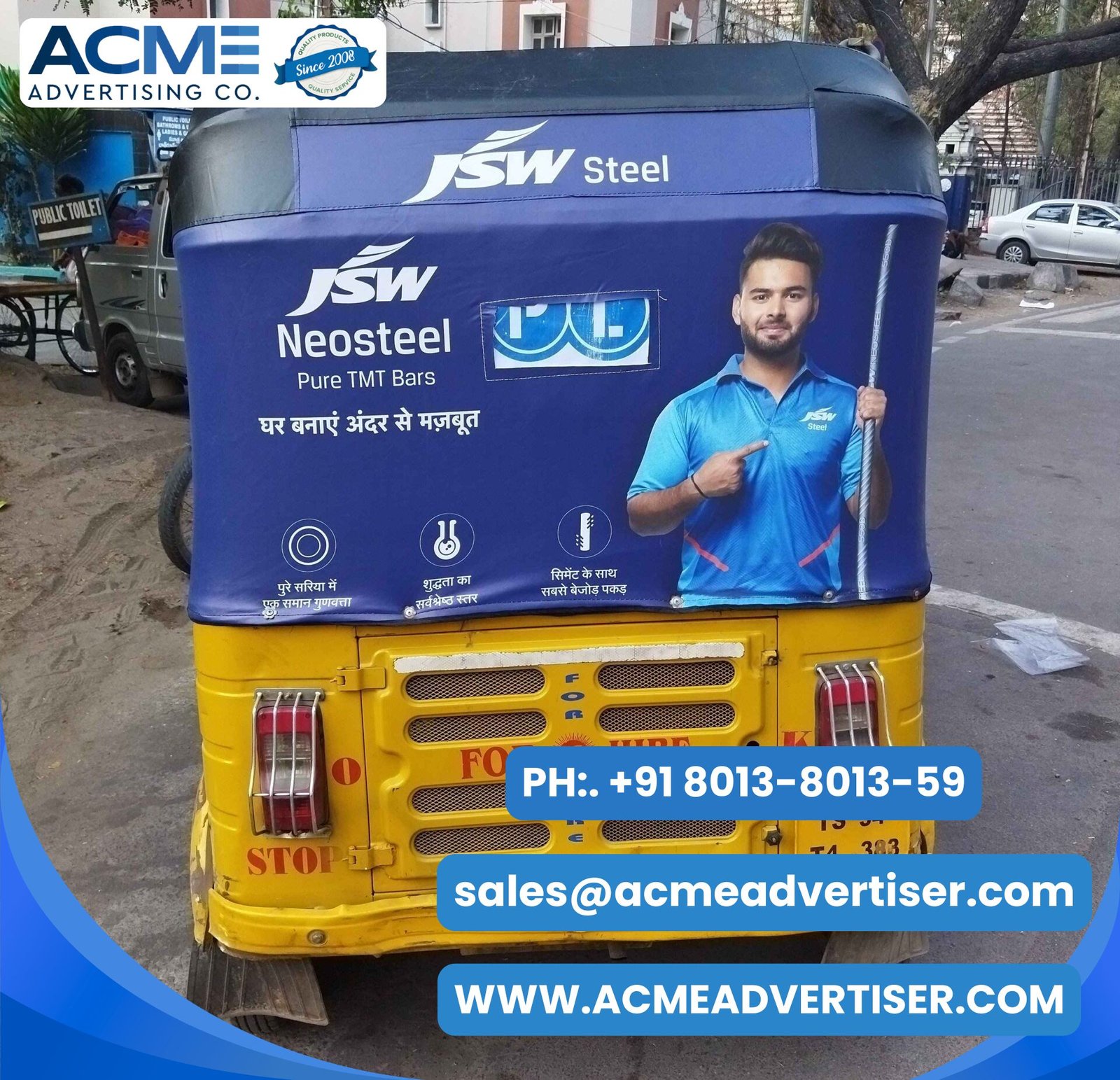
Auto branding advertising campaign promoting steel brand on moving vehicle

Professional Auto Rickshaw Branding Execution

Effective auto branding requires route insight, creative clarity, and structured deployment. Acme Advertising Co. provides professional outdoor advertising services, helping brands execute auto branding campaigns designed for consistent visibility and long-term recall.

Contact us today to explore how our Auto Rickshaw Branding services can help your brand.

Expand your network with us, let’s connect on LinkedIn
Unlocking the Secret Behind High-Performing Radio Campaigns with ACME Advertising Co.

radio advertising

Radio advertising, what you say is important—but when you say it is absolutely critical. In today’s competitive business landscape, brands that understand the role of timing in their campaigns achieve far better reach, engagement, and ultimately, return on investment (ROI). ACME Advertising Co. specializes in crafting radio advertisement strategies that not only deliver the right message but also place it at the right time to capture attention when it matters most.

This article explores why timing is the backbone of successful radio campaigns, how businesses can maximize impact by aligning ads with audience behavior, and why partnering with ACME Advertising Co. ensures your message doesn’t just reach people—it resonates.

MAXIMUM IMPACT
MAXIMUM IMPACT

Why Timing Matters in Radio Advertising

Radio remains one of the most trusted and effective media for connecting with audiences. According to Nielsen reports, radio reaches over 90% of adults weekly. But here’s the catch: people listen to radio differently throughout the day. The same advertisement can have drastically different results depending on when it airs.

Imagine running a real estate ad at 11:30 PM—most potential buyers are asleep, and the money spent goes unnoticed. But running that same ad at 8:00 AM during peak commute hours? Suddenly, you’re speaking directly to a captive audience stuck in traffic, actively thinking about life decisions.Radio Advertising.

This is where ACME Advertising Co. comes in. By analyzing listening patterns, audience demographics, and brand goals, the team ensures your radio advertisement plays when your ideal customers are most attentive.

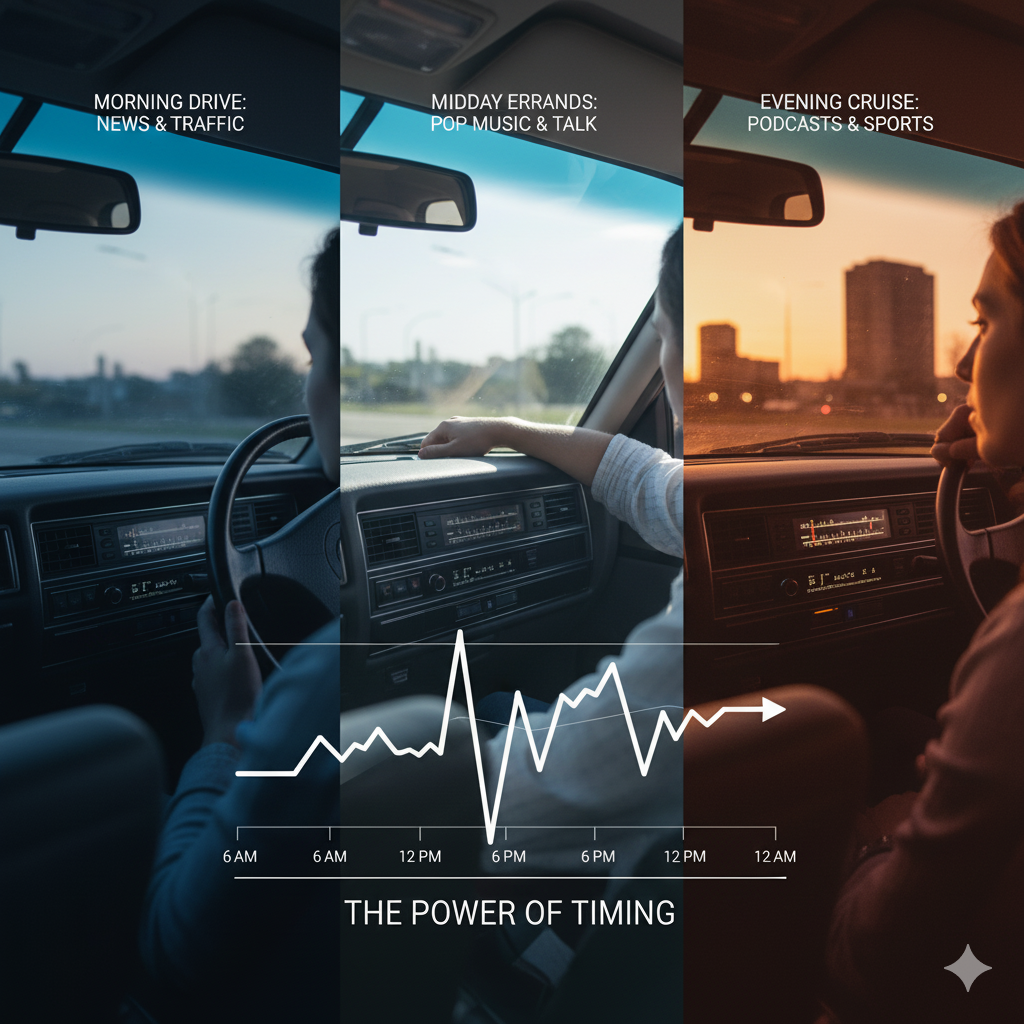
A triptych showing a person driving a car at different times of the day (morning, midday, evening), with a line graph overlaid indicating fluctuating radio listenership throughout the day.

The Science of Timing in Radio Advertisement

Different industries have different “golden hours.” Understanding these windows is crucial:

  • Morning Drive (6 AM – 10 AM): Best for consumer brands, quick services, and fast-moving products. People are alert and making purchase decisions for the day.
  • Midday (10 AM – 3 PM): Effective for business-to-business messages, healthcare, and retail promotions. Audiences are in work or shopping mode.
  • Afternoon Drive (3 PM – 7 PM): Perfect for lifestyle, family services, and retail campaigns. People are commuting back home, making weekend plans, or shopping.
  • Evening (7 PM – 12 AM): Strong for entertainment, dining, and nightlife. Ads during this time feel more relaxed and conversational.

With ACME Advertising Co., businesses don’t need to guess. Campaigns are mapped using proven audience insights, ensuring every second of airtime delivers measurable impact.


Real-World ROI: The Results of Perfect Timing

A healthcare client partnered with ACME Advertising Co. to increase awareness of a new wellness program. Instead of spreading ads randomly throughout the day, the team strategically scheduled spots during mid-morning hours, when stay-at-home parents and retirees were most likely tuned in. The result? A 38% increase in appointment bookings within the first month.

Another retail client saw a 50% spike in weekend foot traffic simply by targeting ads during the Friday evening commute slot. This wasn’t luck—it was the precision of timing, guided by ACME Advertising Co.’s expertise.

These case studies highlight one undeniable truth: great timing transforms good campaigns into exceptional ones. Radio Advertising.


How ACME Advertising Co. Optimizes Your Campaign

Partnering with ACME Advertising Co. means your radio campaign benefits from:

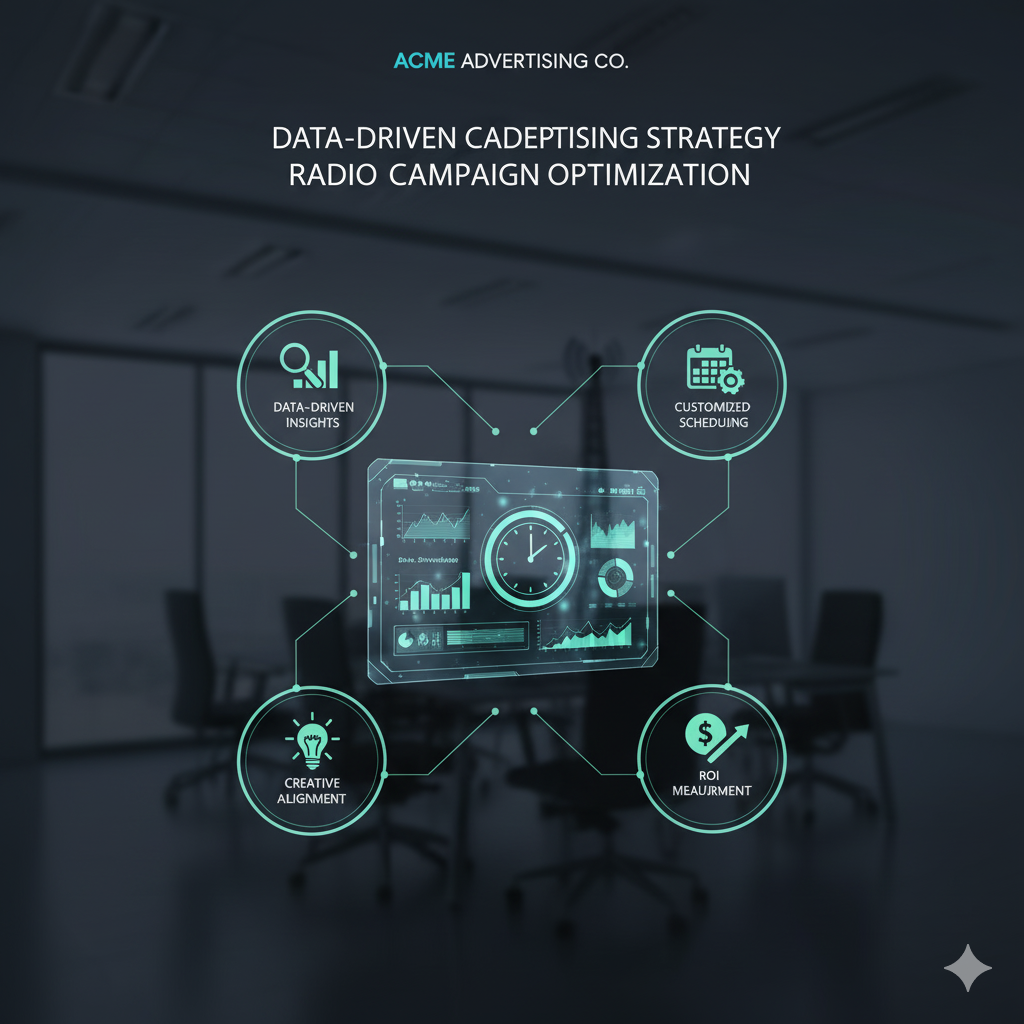
  1. Data-Driven Insights: Identifying when your target audience is most engaged.
  2. Customized Scheduling: Tailoring ad slots to your industry and customer behavior.
  3. Creative Alignment: Ensuring the ad content matches the time-of-day mood (energetic in the morning, conversational in the evening).
  4. ROI Measurement: Transparent reporting on performance and audience response.
A holographic display showing data analytics and a clock, surrounded by four circular icons representing "Data-Driven Insights," "Customized Scheduling," "Creative Alignment," and "ROI Measurement."
A holographic display showing data analytics and a clock, surrounded by four circular icons representing “Data-Driven Insights,” “Customized Scheduling,” “Creative Alignment,” and “ROI Measurement.”

Rather than wasting ad spend on generic placements, ACME Advertising Co. ensures every campaign is intentional and performance-focused.


The Competitive Advantage of Strategic Timing

Many businesses still see radio as “old-fashioned.” The reality? Timing-based strategies make it one of the most cost-effective, scalable, and impactful marketing channels available today. By choosing the right time slots, you can:

  • Increase brand recall by 40–60% compared to untimed campaigns.
  • Drive more direct response calls, website visits, or foot traffic.
  • Strengthen local presence by being heard when communities are most active.

ACME Advertising Co. leverages these timing advantages to give your brand a strong, consistent edge. Radio Advertising.


FAQs on Timing Radio Ads for Maximum Impact

Q1: Why is timing so important in radio advertising?
Because audiences listen at different times of the day. Matching your ads with their listening habits ensures maximum engagement and ROI.

Q2: How do I know the best time slot for my business/radio advertising?
With the expertise of ACME Advertising Co., timing is determined by industry data, audience demographics, and your specific business goals.

Q3: Is morning always the best time for radio ads?
Not necessarily. While mornings have high listenership, the “best” time depends on your audience. For example, nightlife promotions thrive in the evening.

Q4: Can timing really affect sales and foot traffic?
Yes. Businesses that strategically place ads at peak listening hours often see significant increases in leads, calls, and customer visits.

Q5: Are timed ads more expensive than regular ads?
Premium slots may cost more, but ACME Advertising Co. ensures you maximize ROI by aligning spend with impact.

Q6: How long should my radio ad be?
The standard length is 30–60 seconds, but timing is often more important than length. Strategic placement drives results.

Q7: Does radio still work in the digital age?
Absolutely. Radio remains one of the most consumed media channels, and with smart timing, it integrates seamlessly with digital campaigns.

Q8: How does ACME Advertising Co. measure results?
Through tracking tools, response data, and audience analytics, ensuring your campaign delivers measurable ROI.